This blog post will be positioned as the cornerstone of Module 3: Advanced Battery Engineering & Design, offering readers a new and fresh perspective on how EV batteries are assembled. Rather than rehashing previously covered topics, this post will focus on the practical and innovative aspects of the assembly process, such as efficiency optimization, real-world applications, and future design trends.
1. Objectives
Purpose:
- To provide a fresh perspective on how EV batteries are assembled, highlighting efficiency, design innovations, and assembly challenges.
Key Differentiation from Other Sections:
- Unlike previous posts, this blog will delve deeper into assembly optimization, the practical challenges of scaling production, and how battery pack design impacts reliability and performance.
- It will also explore industry-specific assembly innovations like Cell-to-Pack (CTP) and Module-to-Pack (MTP).
SEO Focus Keyword:
“EV battery assembly”
Supporting Keywords:
- Battery pack assembly process
- Modular EV battery design
- Cell-to-Pack innovations
- Efficiency in EV battery manufacturing
- EV battery optimization
2. Blog Outline
Title Options:
- Main Title: Electric Vehicle Battery Breakdown: Cells to Modules to Packs!
- SEO-Friendly Title: Inside EV Battery Assembly: How Cells Form Modules and Packs for Maximum Efficiency
Introduction: The Blueprint of an Electric Future
- Hook:
“How do tiny cells come together to power a 2-ton EV with a 500-kilometer range? The answer lies in the art and science of EV battery assembly.” - Set the stage: Introduce the importance of EV battery assembly, not just for functionality but also for safety, performance, and cost efficiency.
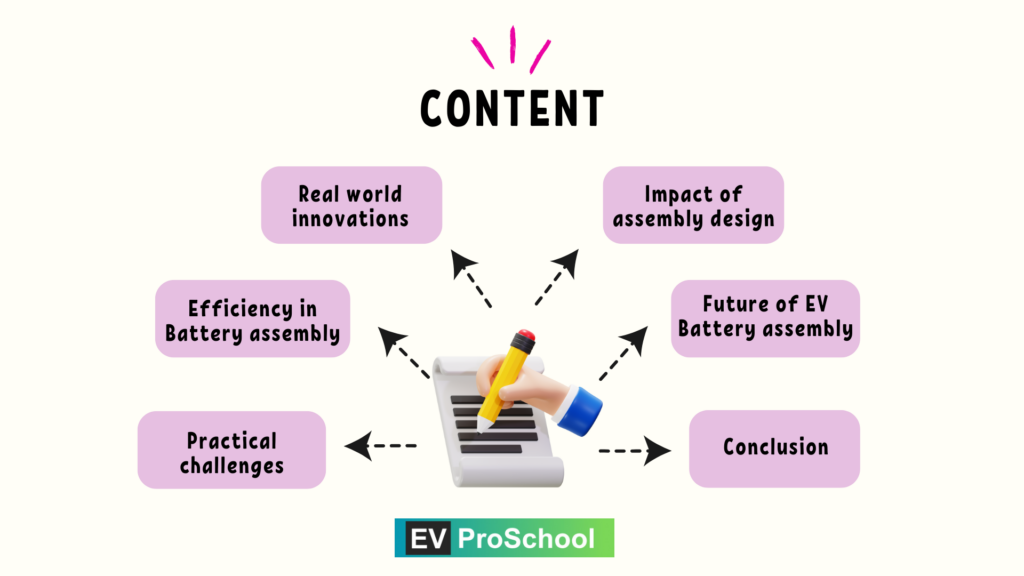
- Preview the blog: “In this post, we’ll uncover the practical steps, challenges, and innovations involved in assembling EV batteries, from cells to packs, and what the future holds for this essential technology.”
Section 1: Practical Challenges in EV Battery Assembly
1. Scale vs. Precision
- Explain how manufacturers balance scaling production while maintaining precision in cell alignment and electrical connections.
- Real-World Example:
- Tesla’s Gigafactories producing battery packs at scale while maintaining high energy density and low defect rates.
2. Thermal Management Integration
- Discuss the complexity of embedding cooling and heating systems during the assembly phase.
- Challenges:
- Ensuring uniform temperature regulation across thousands of cells.
- Minimizing added weight and material costs.
Section 2: Efficiency Factors in Battery Assembly
1. Energy Density Optimization
- Explain how cell arrangement (prismatic, cylindrical, or pouch) impacts energy density at the pack level.
- Innovations like CTP (Cell-to-Pack) remove intermediate layers (modules), improving energy utilization.
2. Weight Reduction
- Explore how manufacturers use lightweight materials like carbon composites for pack enclosures.
- Benefits: Improved vehicle range and reduced manufacturing costs.
Section 3: Real-World Innovations in Battery Assembly
1. Cell-to-Pack (CTP) vs. Module-to-Pack (MTP)
- CTP Approach:
- Eliminates the module layer, increasing energy density by 20-30%.
- Used by BYD and CATL in their flagship EV models.
- MTP Approach:
- Retains modularity for easier repairs and upgrades.
- Examples: Modular designs used in Nissan Leaf.
2. Fully Automated Assembly Lines
- Showcase how robotics and AI are revolutionizing assembly precision, reducing errors, and increasing speed.
- Example:
- Tesla’s AI-driven systems for tabless 4680 cells, which streamline assembly.
Section 4: Impact of Assembly Design on Battery Reliability
1. Structural Integrity
- How battery packs are designed to be load-bearing, reducing the need for additional vehicle weight.
- Example: Tesla’s structural battery packs.
2. Safety Enhancements
- Fireproof barriers and sensors embedded during assembly to reduce thermal runaway risks.
- Innovations like venting systems to release pressure from cells safely.
3. Durability Testing
- The rigorous stress tests packs undergo after assembly:
- Vibration tests for road conditions.
- Temperature cycling to simulate extreme climates.
Section 5: The Future of EV Battery Assembly
1. Solid-State Battery Assembly
- Discuss how the advent of solid-state batteries will revolutionize assembly by removing the need for complex thermal management.
- Benefits: Higher energy density, simpler designs, and improved safety.
2. AI-Driven Assembly Optimization
- Predictive algorithms will enhance precision, reduce defects, and optimize material usage.
3. Sustainability in Assembly
- Recycling-friendly designs to ensure easier disassembly and recovery of materials like lithium and cobalt.
Conclusion: Building the Batteries That Drive the Future
- Recap the key takeaways:
- The journey from cells to packs is not just about functionality but also about efficiency, safety, and innovation.
- Highlight how cutting-edge assembly techniques are shaping the future of EV performance.
- End with a call-to-action:
“Want to learn more about the technology driving EVs? Explore our in-depth guides on battery performance and innovations!”
3. Writing Style and Tone
- Tone: Professional yet engaging, blending technical depth with relatable explanations.
- Use analogies to simplify technical concepts:
- “Think of assembling an EV battery like building a skyscraper—each layer (cell, module, pack) needs to be precisely aligned and structurally sound to support the entire system.”
4. Suggested Visuals and Graphics
- Comparison Chart:
- Cell-to-Pack vs. Module-to-Pack designs.
- Infographic:
- The step-by-step process of assembling an EV battery pack.
- Cross-Section Diagram:
- A battery pack showing thermal management systems, sensors, and electrical connections.
- Future Trends Visualization:
- The transition from traditional lithium-ion packs to solid-state designs.
5. SEO Optimization Strategy
Focus Keyword:
“EV battery assembly”
Supporting Keywords:
- Cell-to-pack structure
- EV battery manufacturing process
- Modular battery assembly
- Future battery pack designs
Meta Description:
“Explore the fascinating process of EV battery assembly! Learn how cells are arranged into modules and packs, the latest innovations like Cell-to-Pack design, and how assembly impacts performance and safety.”
Alt Text for Feature Image:
“Diagram showing the EV battery assembly process from cells to modules to packs, highlighting efficiency and safety innovations.”
6. Blog Length and Target Audience
- Word Count: 2,200–2,500 words for a detailed, in-depth exploration of the topic.
- Target Audience: EV enthusiasts, engineers, researchers, and students interested in battery technology.
This strategy ensures that the blog post offers fresh insights, emphasizing the practical challenges, innovations, and future trends in EV battery assembly, while avoiding repetition from earlier content in the course.