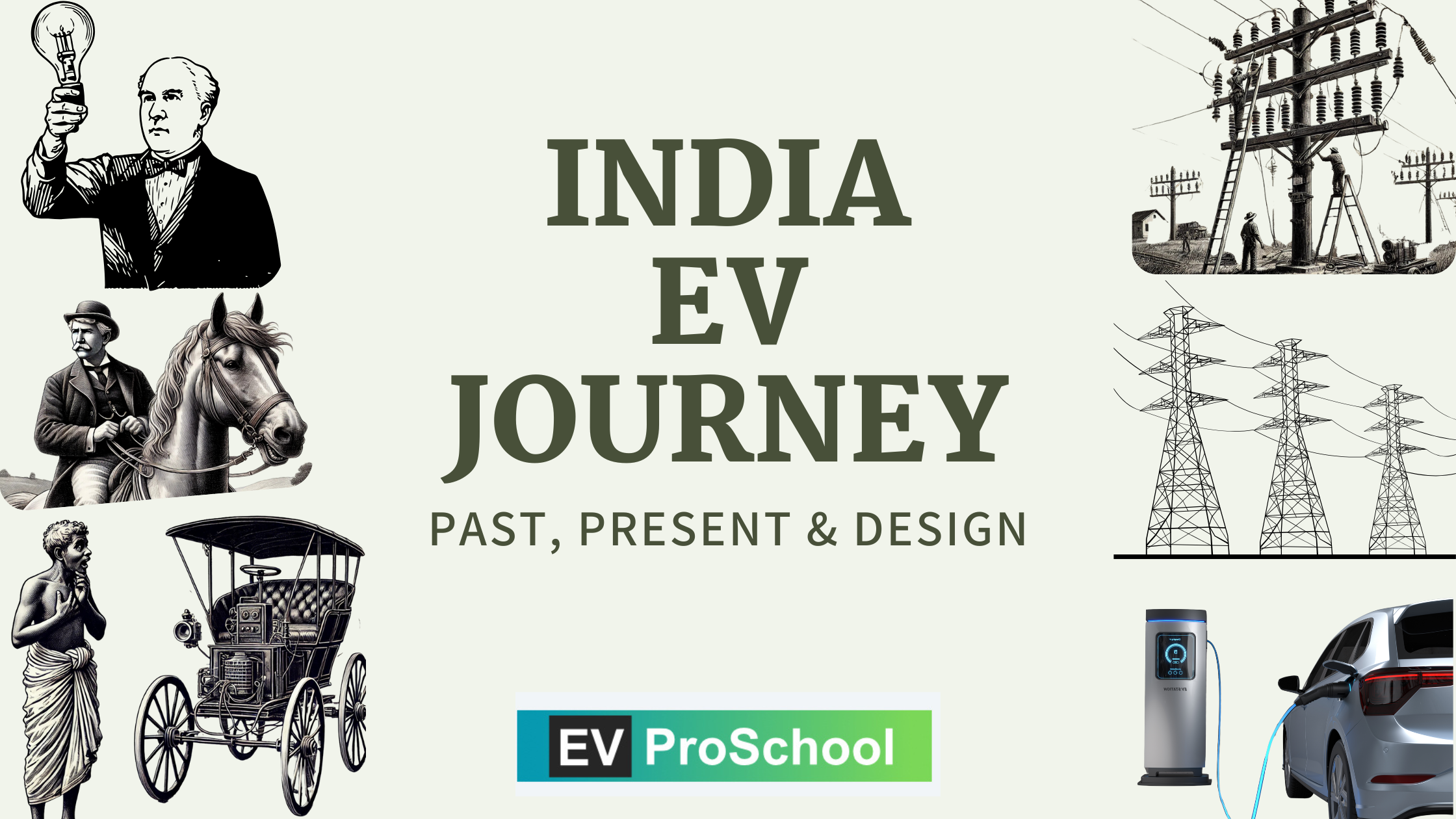
In 1879, Electricity came to India for the first time. From the first electric light illuminating Kolkata to the electric vehicles zipping through modern streets, India’s EV Market journey with electricity has been one of evolution and promise. So is India’s Electric vehicle Journey.
India aims to achieve net carbon zero by 2070, with the “30@30” target driving a major shift toward electric vehicles (EVs). The automobile sector contributes 27% to pollution, making EV adoption critical. As a developing nation aspiring to become a global leader, India’s adoption of and advancements in key EV technologies are crucial for the sustainability of local automotive companies.
For long-term success in EVs understanding the past, assessing current progress, and envisioning the EV design from an Indian perspective is essential. India is growing rapidly, but are Indians merely followers in the EV industry, or are we leading in some areas as well? Let’s dive deeper into the history of EVs in India together.
The Past: India’s EV Market Journey
The Global Context of EVs:
Innovator Thomas Parker in England built early electric cars in 1884, and by 1900, electric cars accounted for about a third of all vehicles on U.S. roads. Advent of Ford’s Model T (ICE) introduced in 1908, offered greater range and affordability. The discovery of starter motors in ICE further killed the EVs. (Ref : Energy)
India’s Early Efforts
The first electric vehicle (EV) in India was introduced in 1912. India’s EV Journey started there. Decades later, the first practical attempt at an EV was made in 1993 with the Lovebird, developed by Eddy Current Controls and Japan’s Yaskawa Electric Company. The Lovebird was powered by a lead-acid battery but faced limitations in infrastructure and performance.
A significant milestone was achieved in 2001 with the launch of the Reva electric car, which gained attention for its compact design and urban suitability. In 2017, Tata Motors introduced its first EV, the Tiago, powered by a 72-volt system.
Explore More :EV Adoption in India 2024: How to Overcome Challenges in Global Trends
The Progress: EV Revolution on Track
Today, every major original equipment manufacturer (OEM) in the passenger vehicle segment has plans to launch EVs, marking a shift in the automotive industry. In the two-wheeler and three-wheeler segments, numerous players have entered the market, driving innovation and further transforming India’s EV landscape.
Government Policy and Push:
The government is actively promoting battery electric vehicles (BEVs) through a range of progressive policies, starting with the FAME (Faster Adoption and Manufacturing of Hybrid and Electric Vehicles) scheme and continuing with initiatives like the latest PM E-Drive scheme. These efforts aim to accelerate EV adoption, enhance infrastructure, and foster sustainable mobility in India.
| Policy Push | Aim | Focus On |
|---|---|---|
| FAME 1 (2015) [Ref] | Create demand for EVs through subsidies. | Two-wheelers, three-wheelers, buses, and hybrids. |
| FAME 2 (2019) | Electrification of public and shared transportation. | Buses, commercial fleets, and private vehicles. |
| NEMMP (2013) | Achieving national fuel security by promoting hybrid and electric vehicles. | 6-7 million EV sales target by 2020. |
| GST Reduction | Reduced GST on EVs from 12% to 5%. | Making EVs more affordable for consumers. |
| Income Tax Deduction | Tax deduction on the interest paid for EV loans. | Loan incentives up to ₹1.5 lakh under Section 80EEB of the Income Tax Act. |
| Scrappage Policy | Phase out old and inefficient vehicles. | Encourage adoption of fuel-efficient and electric vehicles. |
| PM eDrive Scheme (2023) [Ref] | Promote adoption of advanced electric vehicles and manufacturing competitiveness. | High-performance EVs, local production of EV components, and export growth. |
Infrastructure development
The Indian government is also making consistent efforts to rapidly expand the EV ecosystem and establish the necessary infrastructure to support mass adoption. These initiatives aim to create a robust foundation for sustainable mobility and ensure accessibility for a larger population.
| Infra | Focus On |
|---|---|
| Battery Swapping Stations | For two-wheelers and three-wheelers, battery swapping has been proposed as an alternative to charging stations. |
| Grid Upgrades | Initiatives to upgrade the power grid and integrate renewable energy sources to support EV charging needs. |
| Public Transportation | Push to electrify public transportation, including buses and three-wheelers. |
| PLI Scheme for Automobiles & Auto Components | Incentivize manufacturing of EV components, advanced batteries, and electric vehicles to boost domestic production. |
Pioneering Designs: How India is Innovating
Design Tailored for India
With advancements in fast-charging technology, Indian startups are revolutionizing charging times, making EVs more convenient than ever. The rise of software-defined vehicles is paving the way for greater autonomy, while ADAS (Advanced Driver Assistance Systems) is enhancing safety on the roads.
New EV passenger vehicles are now packed with features that were once unimaginable, offering a premium experience to customers. Companies like Ather and Ola are setting global benchmarks in the two-wheeler segment, while Mahindra’s latest Be 6 EV showcases a feature-rich design tailored specifically for Indian consumers. These developments are reshaping the EV landscape in India and beyond.
Energy Storage and Sustanability
Battery manufacturing in India is expanding rapidly with several notable advancements:
- Ola’s Gigafactory: Ola Electric is building India’s largest Gigafactory in Tamil Nadu, with an initial capacity of 5 GWh, scalable to 100 GWh. Ref
- Lithium Reserves in Jammu and Kashmir: India has discovered 5.9 million tonnes of inferred lithium resources in Jammu and Kashmir. However, further exploration is facing challenges related to data and security. Ref
- Battery Recycling Initiatives: Startups like Attero Recycling, Lohum Cleantech, and BatX Energies are leading efforts in recycling lithium-ion batteries and repurposing them for sustainable use.
- MG Motor’s Battery-as-a-Service: MG Motor India offers an innovative Battery-as-a-Service model, enabling customers to pay for battery usage on a per-kilometer basis, reducing upfront EV ownership costs. Ref
Imapact on Community
- Reduction in air Pollution
- Local manufacturing Leads to Economic benifit
- Cost Saving on Fuel
- Integration with Renewable Energy
- Reduce Noise Pollution
- New Jobs and Investment in new tech
- EV Public transport (Neat & Clean)
The Future: Is India Leading or Following
Leading Indicators
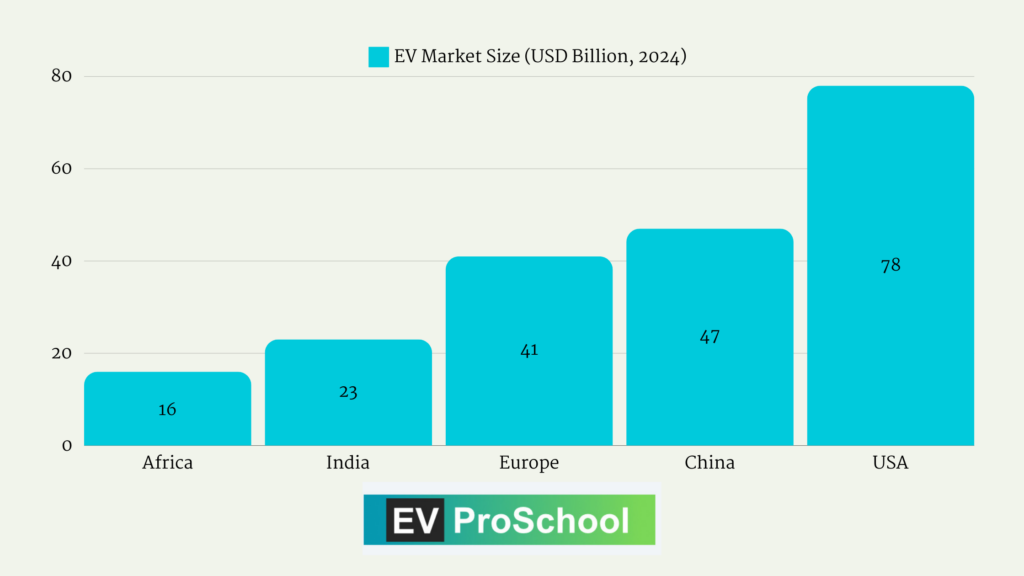
India is witnessing significant EV growth driven by strong policy support and incentives , alongside rapid infrastructure development enriched by innovative startups. Battery manufacturing and recycling are making steady progress, while companies are offering reduced interest rates and better financing options, supported by improved warranty claims from OEMs. Local Indian OEMs are actively filing patents and advancing technology, boosting the sector’s innovation. Additionally, corporate commitments to carbon neutrality are playing a key role in accelerating the adoption of EVs across the country.
Vision for Leadership
A total of ₹25,938 crore has been allocated for the period FY23 to FY27 to promote zero-carbon vehicles (ZEVs), deep localization, and advanced auto-tech innovation. These initiatives are establishing a robust supply chain and fostering industry growth. Policy Allocation under PLI : ₹25,938 crore (FY23-FY27). Vehicle Penetration: Currently, India has only 30 cars per 1,000 people, compared to 600 cars per 1,000 people in developednations. This indicates immense growth potential.
Nitin Gadkari, Union Minister of Road Transport and Highways, has expressed optimism about India’s automotive industry, predicting it will become the global leader within the next five years. The combined efforts under the PLI scheme, coupled with advancements in infrastructure and corporate commitments, are positioning India as a dominant player in the global EV market.
Conclusion
From the first EV introduced in 1912 to the advancements of 2024, India has undergone a significant EV revolution. The “30@30” target is reshaping the nation’s vision for electric mobility, supported by government schemes, policies, and innovative startups driving BEV adoption for customer satisfaction. Consumers focused on total cost of ownership are finding value in EVs, though much work remains to be done. The first step is to understand the current landscape before diving deeper. In the next section, we’ll explore the basic components of EVs.
We’d love to hear your thoughts! What excites you the most about India’s EV revolution? Share your insights, questions, or ideas in the comments below. Let’s spark a conversation about how we can drive the future of sustainable mobility together! 🚗⚡