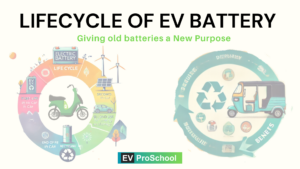
Introduction: A Journey Beyond the Road
- Hook the reader:
“What if your EV battery’s journey didn’t end when your car’s life did? Welcome to the exciting world of EV battery lifecycles, where science, innovation, and sustainability collide.” - Highlight the importance of understanding the lifecycle to reduce environmental impact.
- Preview the blog: explain that we’ll explore chemistry, lifecycle stages, and second-life uses.
Understanding the EV Battery Lifecycle
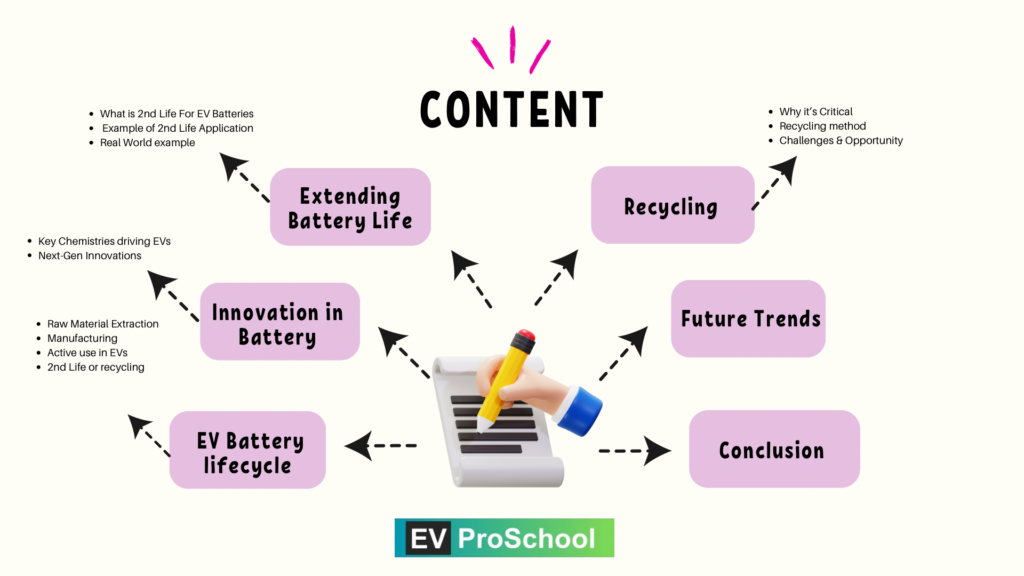
- Define the lifecycle of an EV battery: from raw material extraction to reuse and recycling.
- Key Stages to Cover:
- Raw Material Extraction:
- Materials like lithium, cobalt, nickel, manganese.
- Challenges with mining and environmental concerns.
- Manufacturing:
- How cells, modules, and packs are created.
- Focus on innovations like Tesla’s 4680 cells.
- Active Use in EVs:
- Batteries typically last 8-15 years.
- How performance degrades over time.
- Second Life or Recycling:
- Batteries can be repurposed or recycled for new uses.
- Raw Material Extraction:
Innovations in Battery Chemistry
- Key Chemistries Driving EVs Today:
- Lithium-Ion (Li-ion): Most common due to high energy density.
- LFP (Lithium Iron Phosphate): Cheaper and safer for long-lasting vehicles.
- NMC (Nickel-Manganese-Cobalt): Balances cost, performance, and lifespan.
- Next-Gen Innovations:
- Solid-State Batteries: Increased safety and energy density.
- Sodium-Ion Batteries: A cheaper, sustainable alternative to lithium-ion.
- Recycling-Optimized Chemistry: Batteries designed with easier material recovery.
Extending Battery Life with Second-Life
- What Is Second Life for EV Batteries?
- Batteries with degraded EV performance (below 80% capacity) can still store energy.
- Examples of Second-Life Applications:
- Energy Storage Systems (ESS): Store renewable energy for homes and businesses.
- Grid Stabilization: Support power grids during high demand.
- Portable Power Devices: Repurpose for tools, chargers, or small systems.
- Real-World Examples:
- Nissan’s reuse of Leaf batteries for residential energy storage.
- Tesla’s Powerwall integrating second-life batteries.
Recycling: Closing the Loop
- Explain why recycling is critical: minimizes waste and reliance on mining.
- Recycling Methods:
- Mechanical Recycling: Shredding batteries to extract raw materials.
- Hydrometallurgical Recycling: Using chemicals to recover metals.
- Direct Recycling: Reusing parts of batteries with minimal processing.
- Challenges and Opportunities:
- Limited infrastructure for recycling.
- Innovations in closed-loop systems like those by Redwood Materials.
Future Trends in Battery Sustainability
- Predict the future:
- Longer-lasting batteries to minimize waste.
- More efficient second-life technologies for energy storage.
- Global push for stricter recycling laws.
- Highlight the role of AI and data in optimizing battery usage and recycling.
Conclusion
- Summarize the battery lifecycle and emphasize how chemistry, reuse, and recycling are driving sustainability.
- Call to Action:
“As EVs continue to transform transportation, understanding the battery lifecycle is key to a greener tomorrow. Want to learn more? Explore our guide to EV battery chemistry today!”
Visual and Engagement Ideas:
- Infographic: A circular diagram showing the EV battery lifecycle.
- Chart: Comparison of current vs future battery chemistries.
- Case Study: Highlight Nissan’s second-life battery initiative or Tesla’s closed-loop recycling.
- Call-to-Action Poll: Ask readers, “What excites you most about EV batteries: solid-state tech, second-life uses, or recycling innovations?”
Blog Length:
- Target: 1,800–2,000 words, blending technical details with relatable examples.
This strategy ensures a captivating and informative post that will resonate with both EV enthusiasts and sustainability advocates.
Electric vehicles (EVs) have emerged as a promising solution to address the environmental impact of traditional combustion engine vehicles. At the heart of every electric vehicle lies its battery system, a critical component that determines the vehicle’s range, performance, and overall efficiency. In this blog post, we’ll delve into the fascinating world of battery systems in electric vehicles, understanding their key components, working principles, and the ongoing advancements shaping the future of sustainable transportation.
Battery Chemistry
Electric vehicle batteries come in various chemistries, each with its unique set of advantages and limitations.
Popular Battery Chemistries:
- Lithium-Ion (Li-Ion): The most prevalent battery chemistry due to its high energy density, lightweight, and relatively low self-discharge rate.
- Solid-State Batteries: An emerging technology with the potential to offer higher energy density, improved safety, and faster charging times.
- Nickel-Metal Hydride (NiMH): Commonly used in hybrid vehicles, offering good energy density and durability.
- Lithium Iron Phosphate (LiFePO4): Known for its safety, long lifespan, and thermal stability.
- Sodium-Ion (Na-Ion): An alternative to Li-Ion batteries, utilizing sodium ions for energy storage.
Battery Management System (BMS)
A crucial component in every electric vehicle battery system is the Battery Management System (BMS).
Working Principle: The BMS monitors the battery’s performance, temperature, voltage, and state of charge. It ensures that the battery operates within safe limits, prevents overcharging or over-discharging, and optimizes battery usage for longevity and efficiency.
Advantages:
- Ensures the safety and reliability of the battery pack.
- Enables efficient energy utilization and extends battery lifespan.
- Provides real-time data to the vehicle’s onboard computer for accurate range estimation.
Charging Infrastructure
Charging infrastructure is an essential aspect of electric vehicle adoption, influencing charging times, convenience, and driving range.
Types of Charging Infrastructure:
- Level 1 Charging: Standard household outlets with low power, suitable for overnight charging.
- Level 2 Charging: Dedicated charging stations with higher power output, significantly reducing charging times.
- DC Fast Charging: High-power stations that can rapidly charge the battery to a substantial percentage in a short time.
Advancements: Ongoing developments in charging technology are focused on ultra-fast charging, wireless charging, and vehicle-to-grid integration, further enhancing the EV charging experience.
Battery Recycling and Second Life
As electric vehicles become more prevalent, battery recycling and repurposing are critical for sustainability.
Battery Recycling: Recycling processes extract valuable materials like lithium, cobalt, and nickel, reducing the environmental impact of battery disposal.
Second Life: After reaching the end of their useful life in vehicles, batteries can find a second life in energy storage applications, extending their usefulness and reducing waste.
Conclusion:
Battery systems are the backbone of electric vehicles, powering the transition to a cleaner and greener transportation future. Understanding the various battery chemistries, the significance of battery management systems, and the advancements in charging infrastructure is crucial for embracing and promoting electric mobility.
At EV PRO School, we are committed to providing learners with comprehensive knowledge about battery systems and all aspects of electric vehicles. As the electric vehicle industry continues to evolve, staying informed about battery technologies and sustainable practices will empower you to actively contribute to the electrified and sustainable transportation revolution.